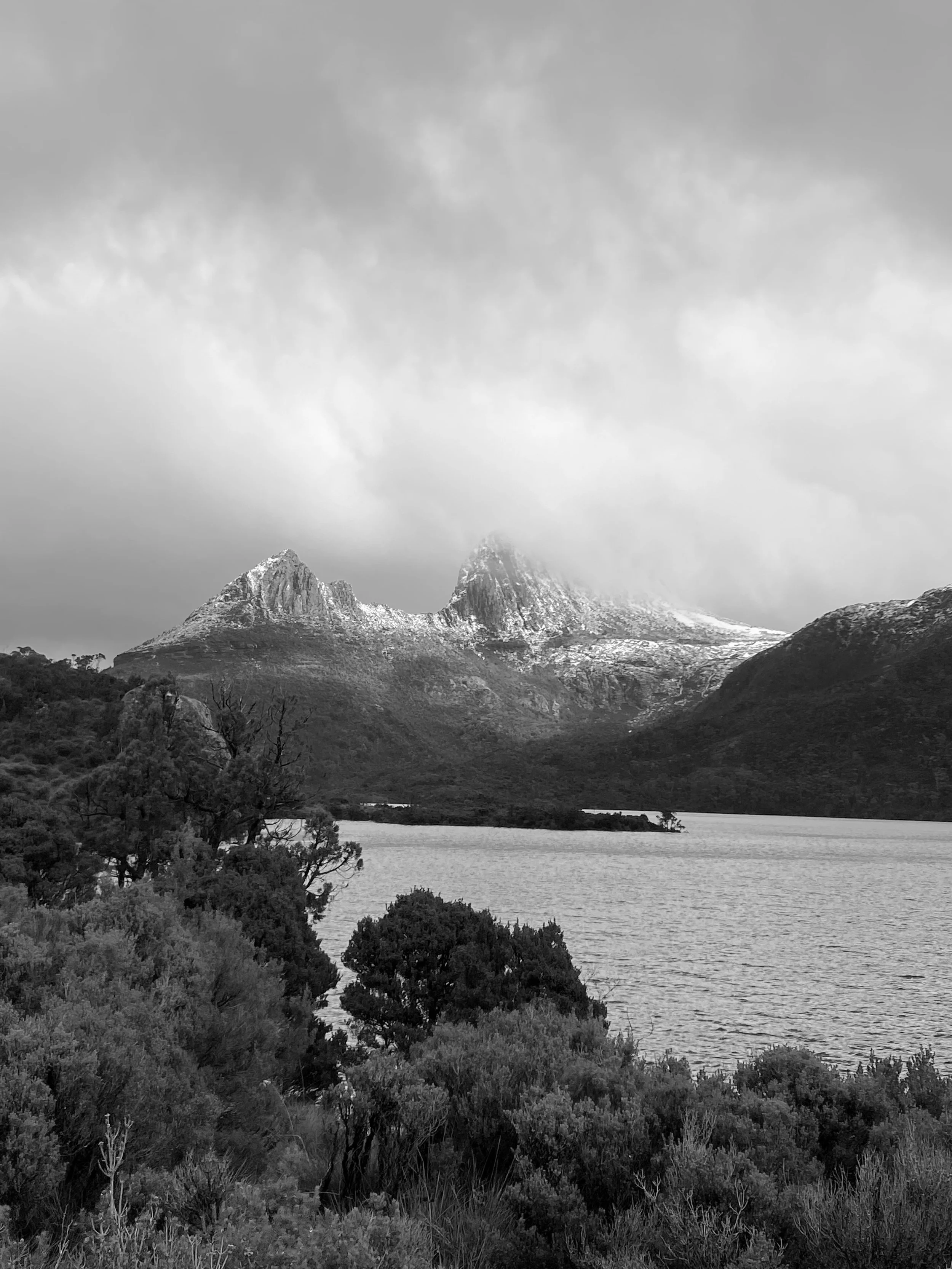
A Tasmanian Loop
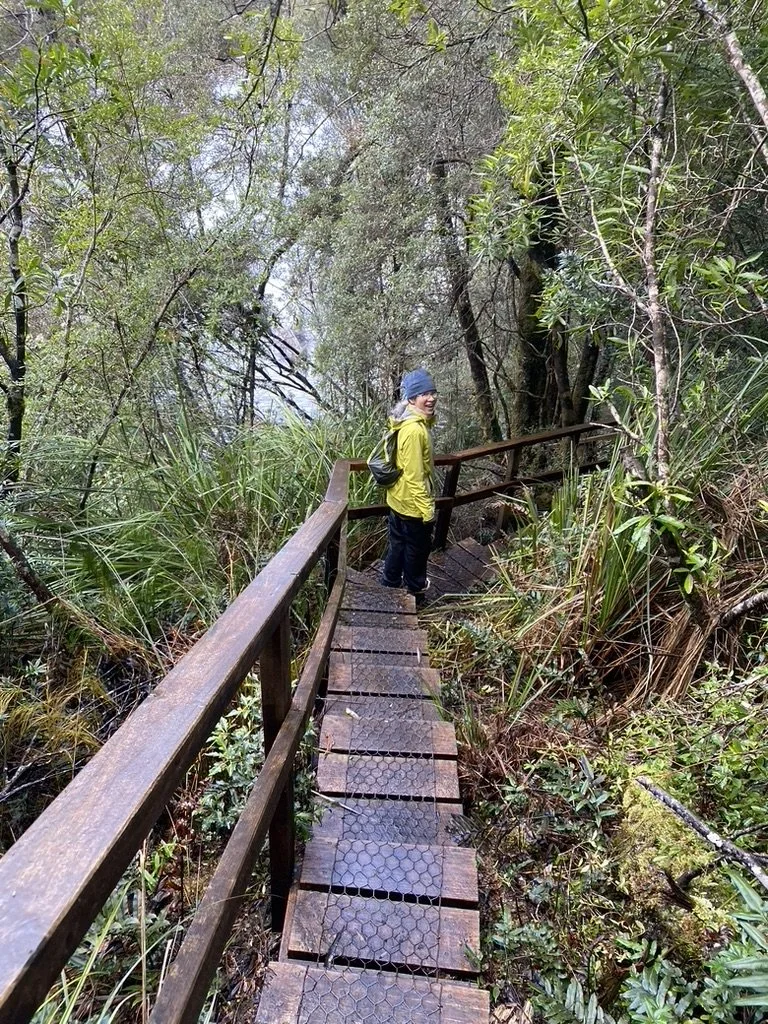
I had been aware of Tasmania’s reputation for having a stunning natural landscape, so it was with some trepidation on my part that my partner and I decided to tour the northern half of the island, even though she had seen most of it before and some parts several times. I figured, as well-travelled as she is, it must be good for her to want to return again.
The idea was to spend the first half of the trip ‘roughing it’ and the second half in deserved luxury – but still overall a nature-based journey. This would all be achieved with a clockwise loop starting and finishing at Launceston, making a cross section of the northern half of the island including an adventure on Maria Island on the east coast.
Launceston was an unexpectedly delightful start to the journey. I had visited it for business some twenty years ago, when it was somewhat dour, grey and sodden to say the least. And while the climate did not appear to have changed much, it felt brighter, a little more contemporary, but not yet spoiled. A secret gem. We departed after the mandatory browse in Paddy Pallin and a big breakfast and coffee experience that caused me to start thinking about moving to this city!
We had chosen a rental car that was ostensibly the same as my partner’s car – the ubiquitous Corolla hybrid – mainly for the no nonsense insurance policy. I had my doubts as I had always felt a bit claustrophobic in her car with it’s limited visibility, compared with that of an SUV. However, once we were clear of Launceston heading north-east, it became clear that we had chosen well and with some luck, as we had the sport version which made the glorious mountains and green valleys a two-and-a-half hour breeze to the Blue Tier Giant Walk in Weldborough.
I had chosen the Blue Tier Giant Walk the evening before as a place of interest on the way to our first night camping in the Bay of Fires. It proved to be a stunning find. Just a brief one-and-a-half-hour loop walk, but through the kind of enchanting forest that feels like it belongs in a fairytale. Everything smothered in a furry green moss, vivid in shafts of descending sunlight. Gondwana myrtles, writhing vines and huge splaying ferns gave it that Jurassic feel and the only giants to be seen were the gargantuan Eucalyptus regnans (aka swamp gum, stringy gum, mountain ash, giant ash). We spent about fifteen minutes with Centurion, posing with, basking in and circumnavigating the tallest flowering tree in Australia and the world.
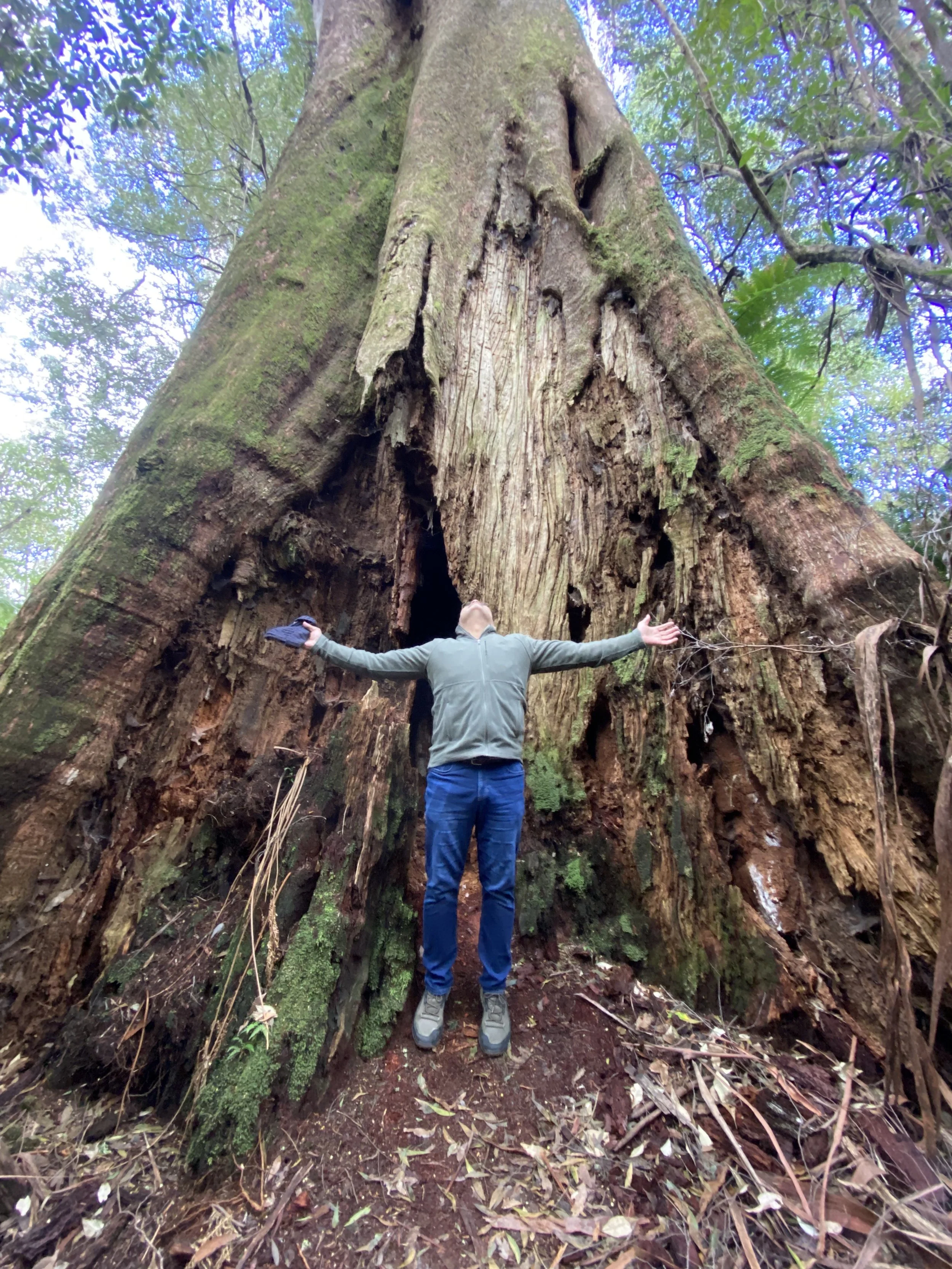
Standing with Centurion
The day’s dallying in big breakfasts and ancient forest had distracted us from the goal of getting to the Bay of Fires in time to set up camp and luxuriate in a sunset. We pressed on not knowing what we would find in terms of campsite availability at Swimcart beach. So we were relieved to find as we arrived that it was by no means busy and probably only half full. There were several sections, which we quickly reconnoitred, before settling on a nook with no other tent or 4WD in sight. We erected our tent before my partner, being more organised than I, quickly made for the beach less than a minute walk away while I wrestled with my gear. Finally I joined her, although I had missed the best part of the sunset. Still, the glowing light and deepening hues on an otherwise empty beach were striking, the granite boulders carpeted with orange lichen giving the place its name. After a basic hiking dinner on the beach we went to bed early, keen to rise before dawn for the much anticipated sunrise. It did not disappoint.
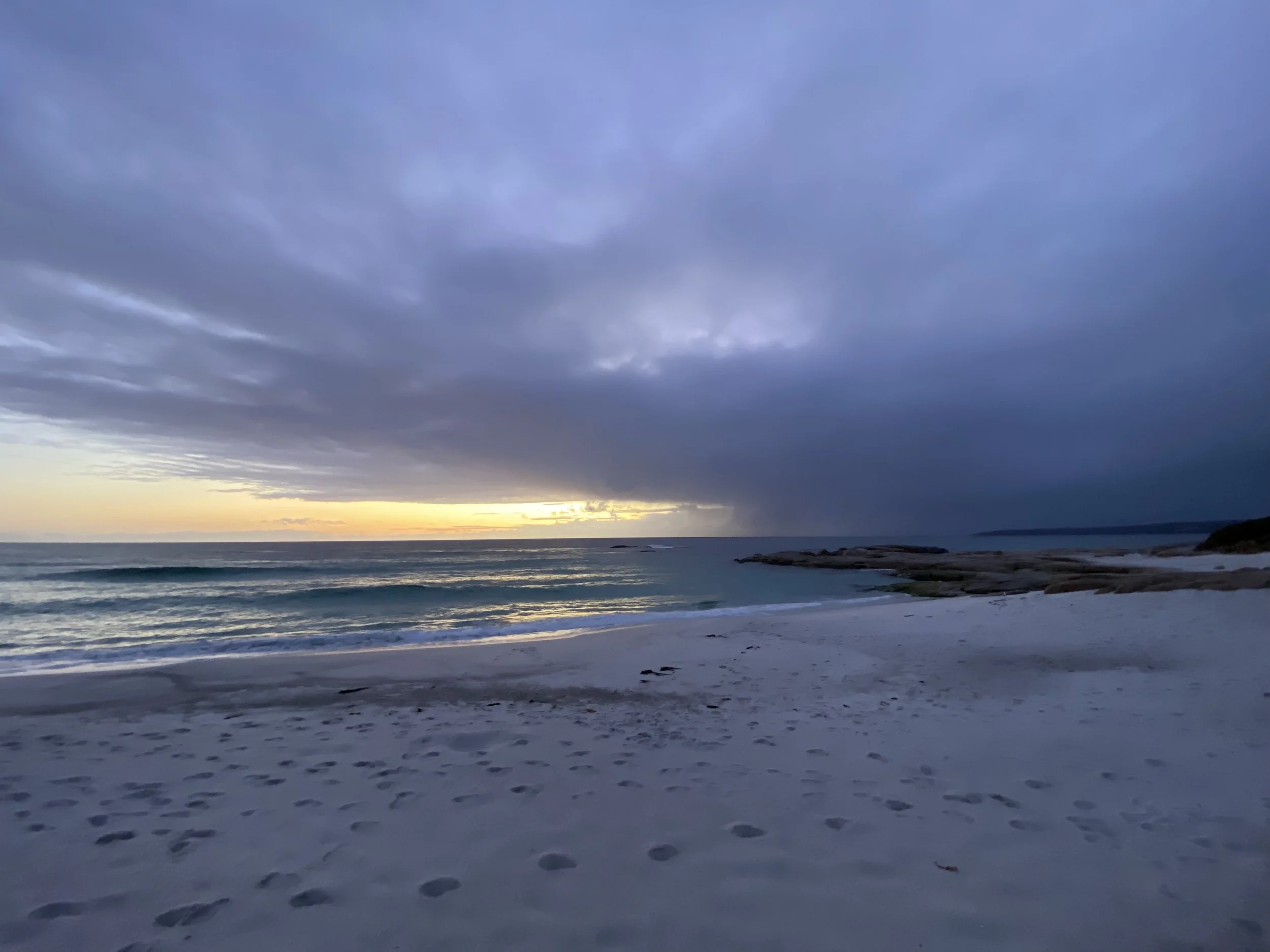
Early morning hues
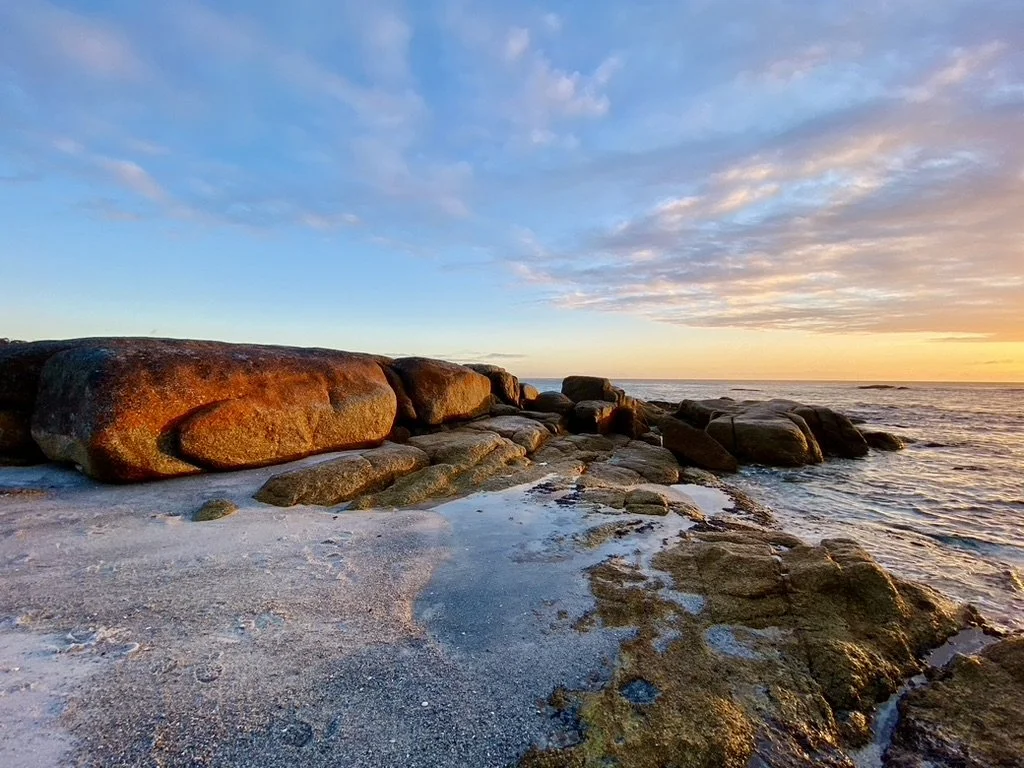
The Bay of Fires
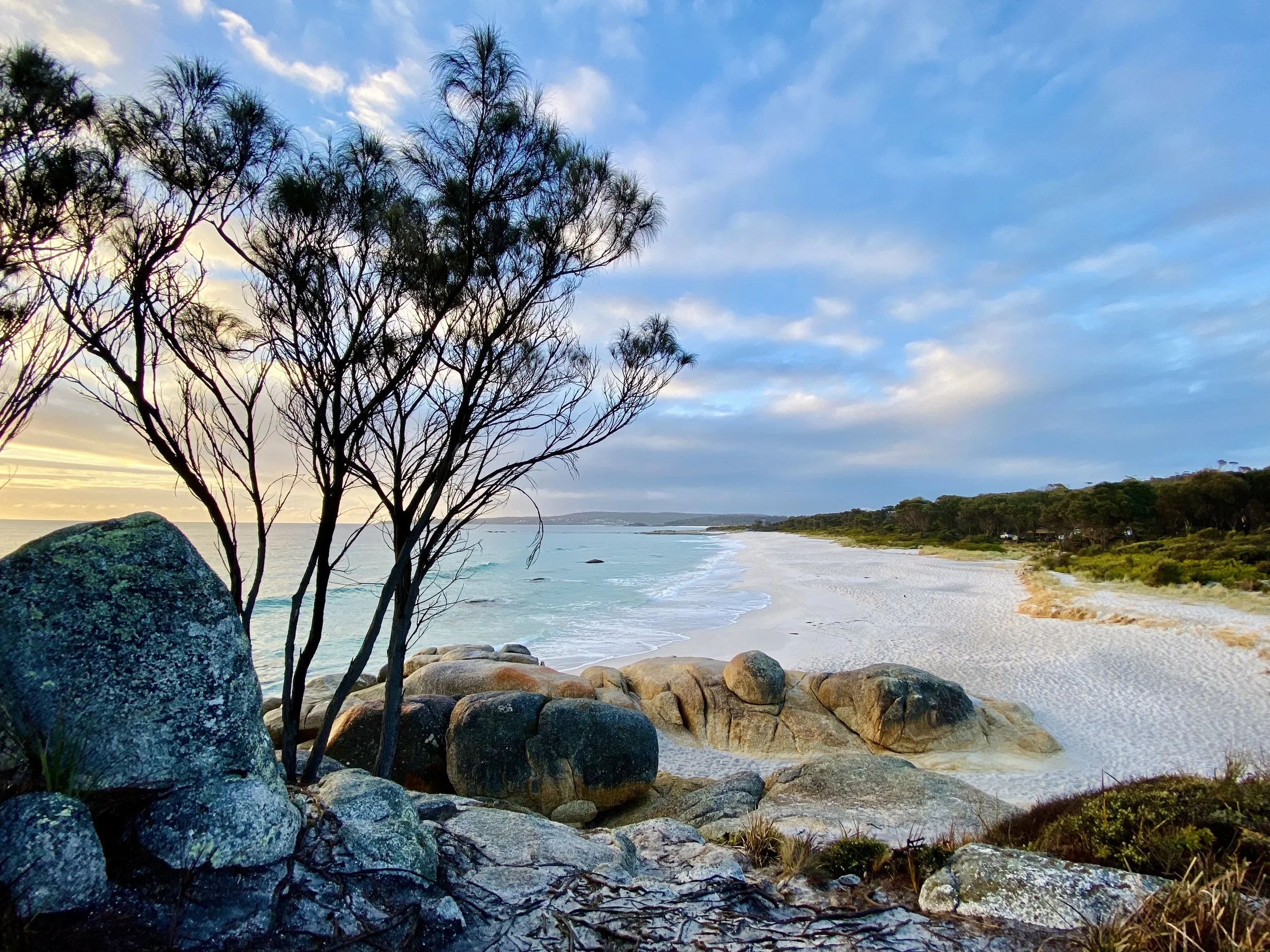
A beautiful morning
The following day we made our way down the east coast close to Freycinet, where we stayed in a chalet after a day of walking with tourists to Wineglass Bay lookout. It was pleasant enough, but the real ‘roughing it’ was soon to come. The weather turned in the evening and rain was forecast for our first day hiking on Maria Island the next day, so we practiced our setting up tent routine lest we had to do it in the wet. We treated ourselves to some pizza and wine before the coming three days of dehydrated food.
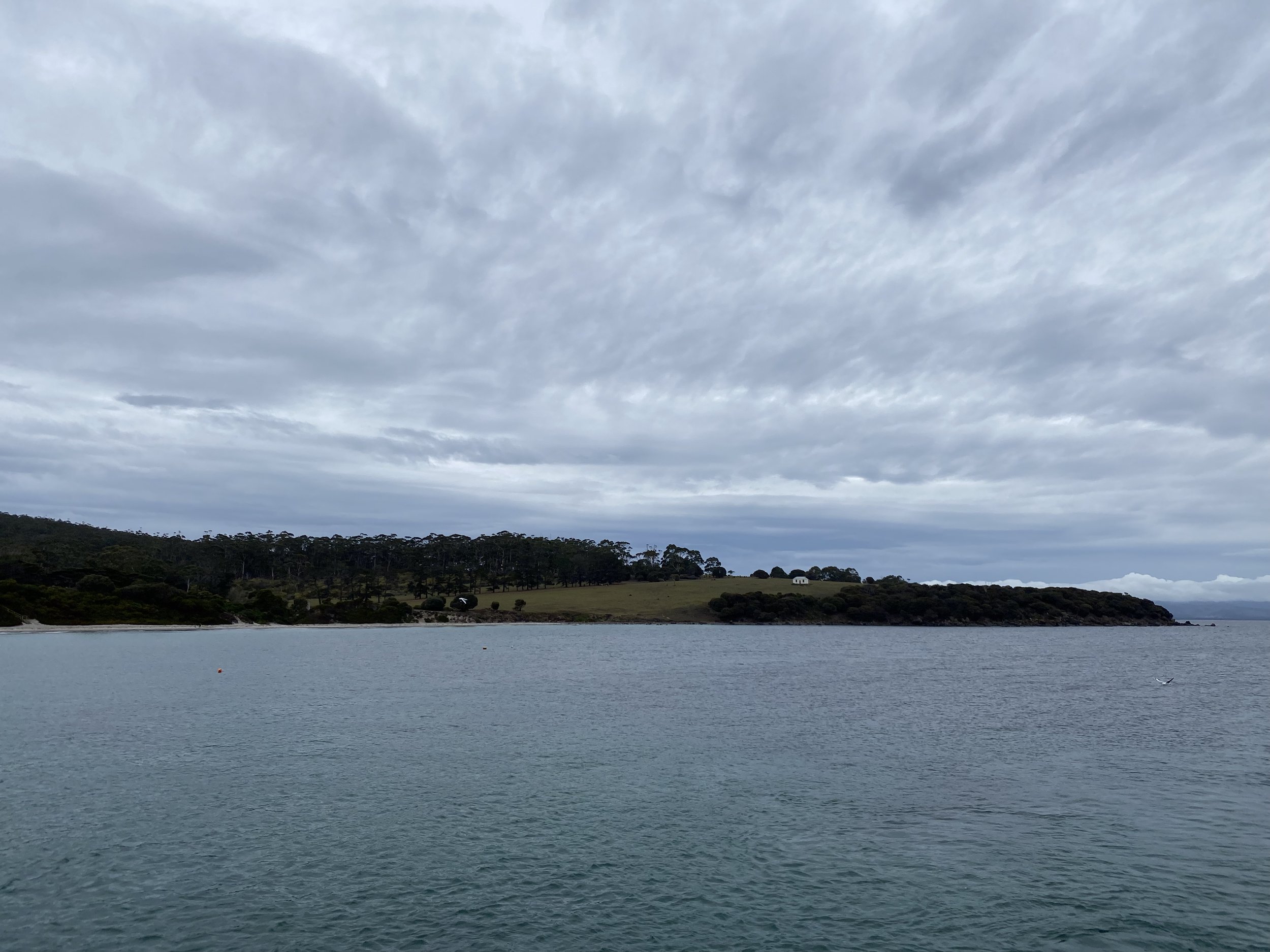
We woke to moody grey skies and made our way down to the ferry terminal, where we joined many day trippers who no doubt would be looking for Instagram shots of the famed and utterly cute Tasmanian wombats. Maria Island was a former penal colony which has retained many of the original buildings, now restored to basic facilities such as a mess house, information hut, basic bunk lodgings with communal BBQ area and camp sites all within the settlement of Darlington. There were no shops for provisions on the island, no cars allowed and you have to take all your rubbish back to the mainland with you. A perfect getaway for the multi-day hike we were about to embark upon.
We marched down to French’s Farm where the grey skies finally released some of their burden. At least we were welcomed by a resident wombat who came up to me to say hello. Setting up camp quickly in light rain provided the first of several physical and mental tests, significant for me as this was my first proper multi day hike. We had the old farmhouse and grounds to ourselves which enabled us to take dinner in relative comfort by the light of our head torches.
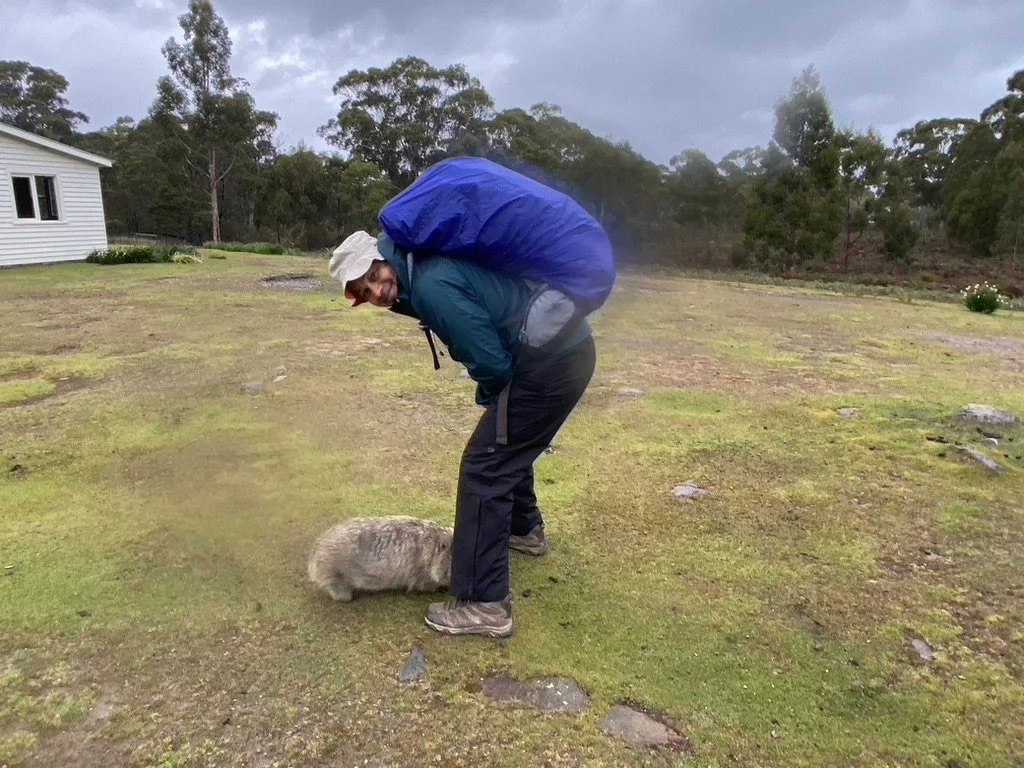
An inquisitive, if not warm welcome
Under blue skies the next day, I proved my fitness with a modicum of reassurance as we summited Mount Maria after a precarious boulder scramble. The march back to camp completed a twenty-four kilometre, eight hour effort. Sadly, we did not make it in time for sunset and our tired mood left the day in somewhat of an anticlimactic outcome. The following day however, again under bright skies, we slogged back to Darlington, set up camp and hiked up to the summit of Bishop and Clerk, another rock scramble bolstering my sense of physical and mental achievement. Back at camp the mood was jovial with our fellow residents, warming ourselves by the fire while entertained by another couple’s predicament, of having not one but two quolls invade their tent. It had been an epic experience for me and I have written about it in more detail in the feature Maria Island ~ Probation. The following morning we returned on the ferry in search of a well-earned feast of fresh food.
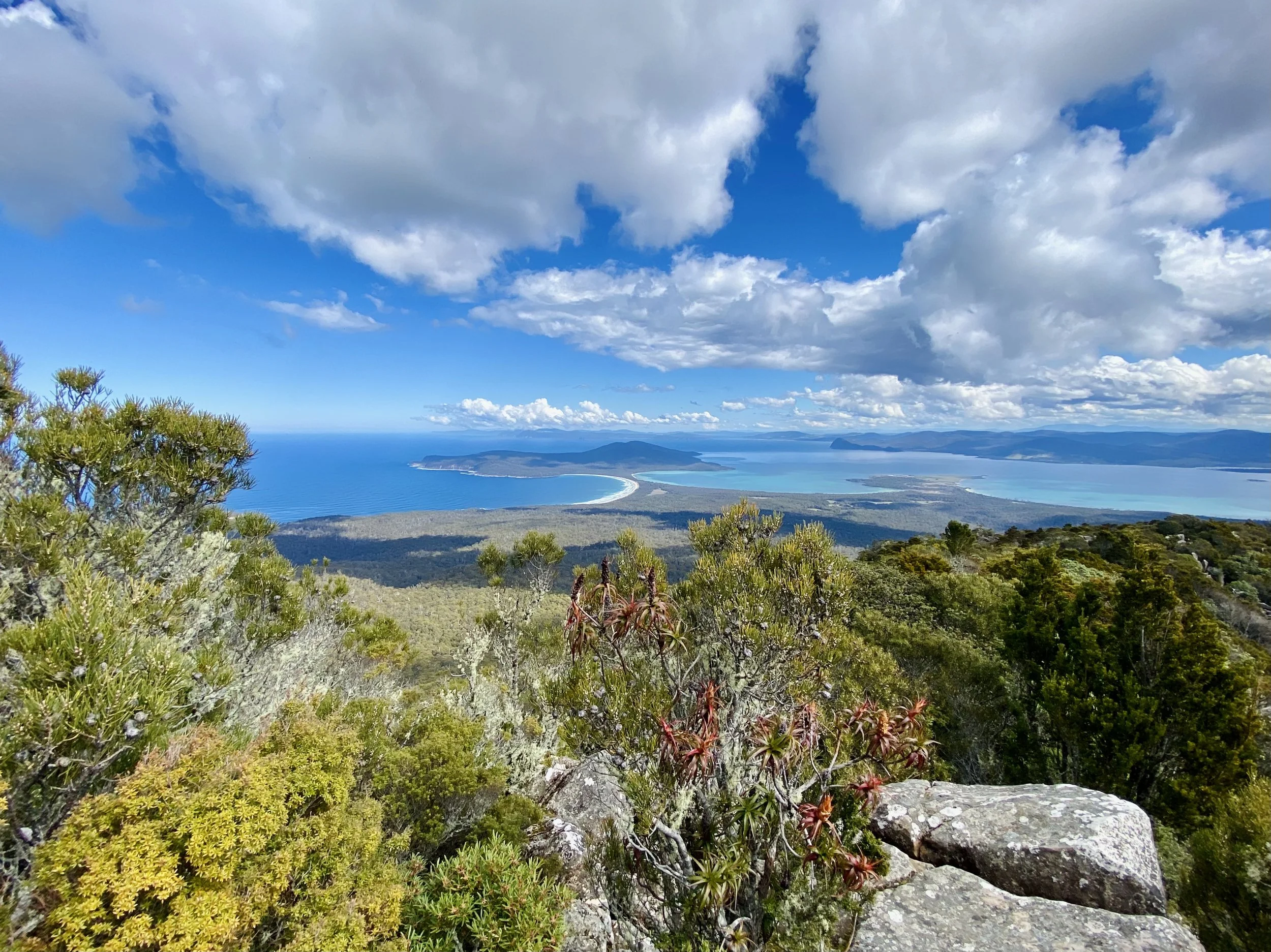
Mt Maria summit
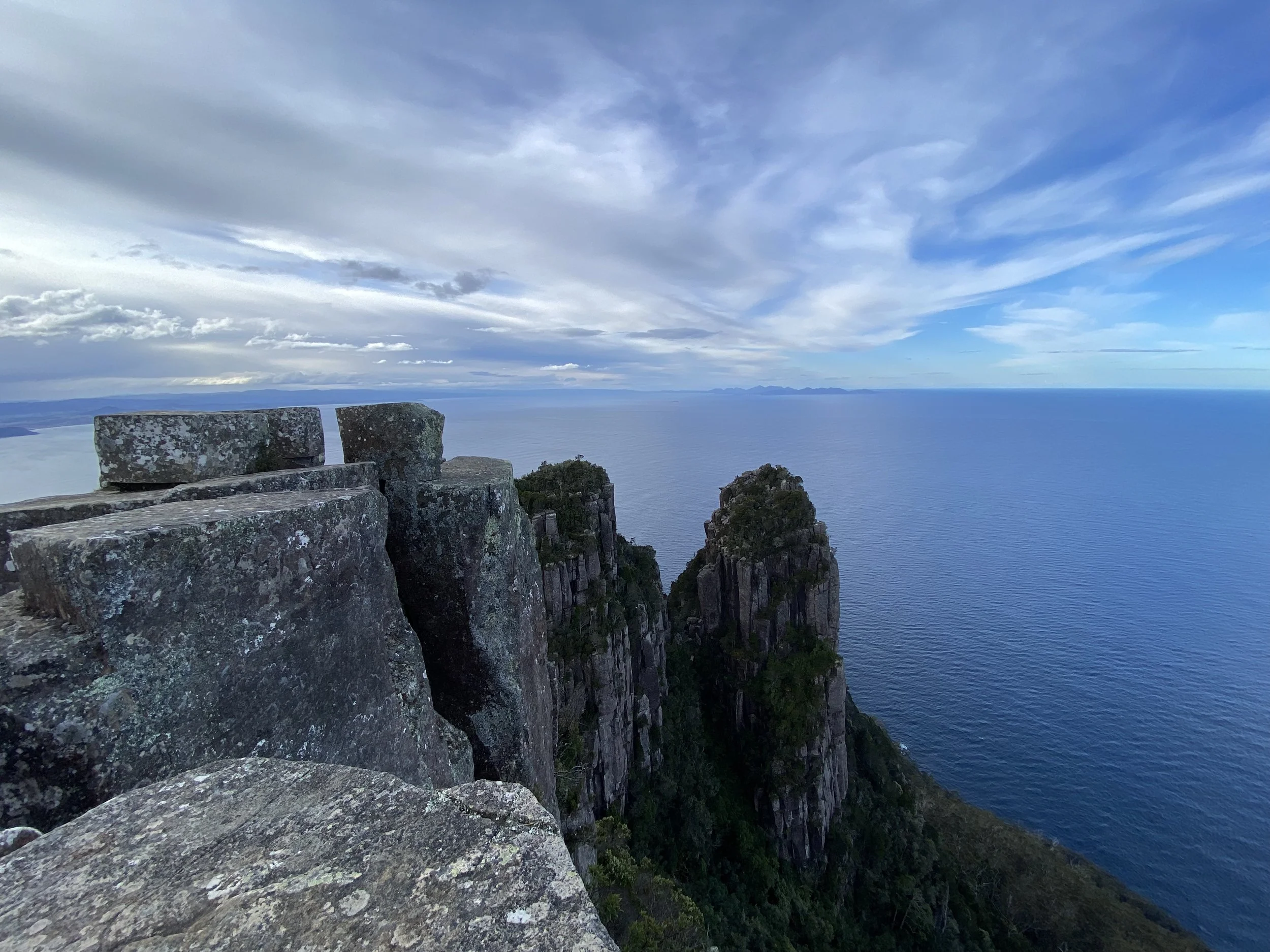
As with Mt Maria, the summit of Bishop and Clerk was worth the slog and a better walk in general
Satiated from the hearty fare of the closest well-rated cafe nearest to the ferry terminal on the mainland, we pressed on towards our accommodation treat – The Doctor’s – an Airbnb located on Lake Sorell, Interlaken in the Central Highlands. Greeted by two friendly sheep and a thoughtful message board with our names on it, it soon became apparent that the owners had impeccable taste and an attention to detail that justified the expense. With the lake within meters, our own pier, outside fire pit, inside fire, fine dining accoutrements and multifarious paraphernalia, it was as close to perfect as you could imagine.
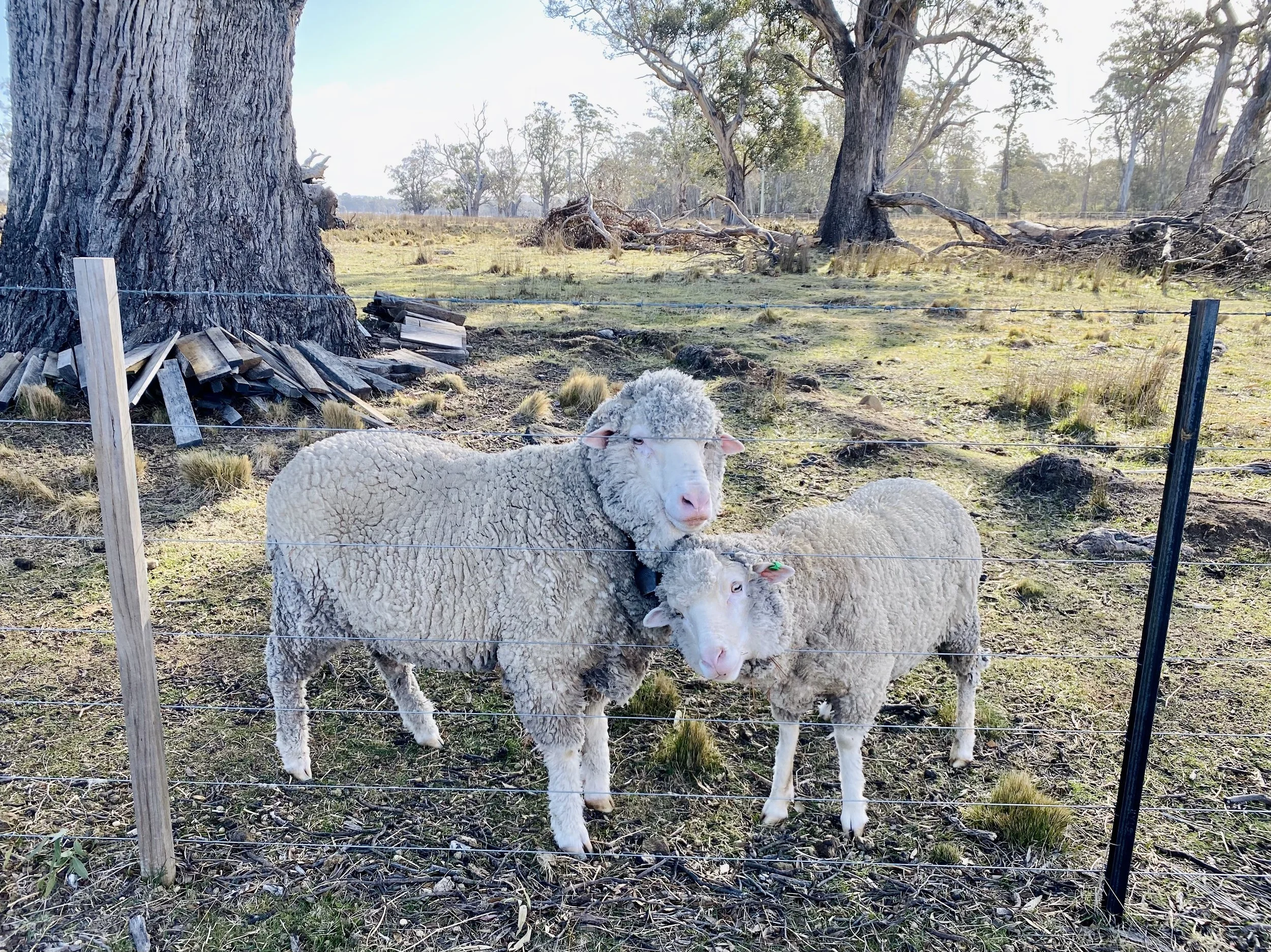
A woolly welcome to The Doctor’s
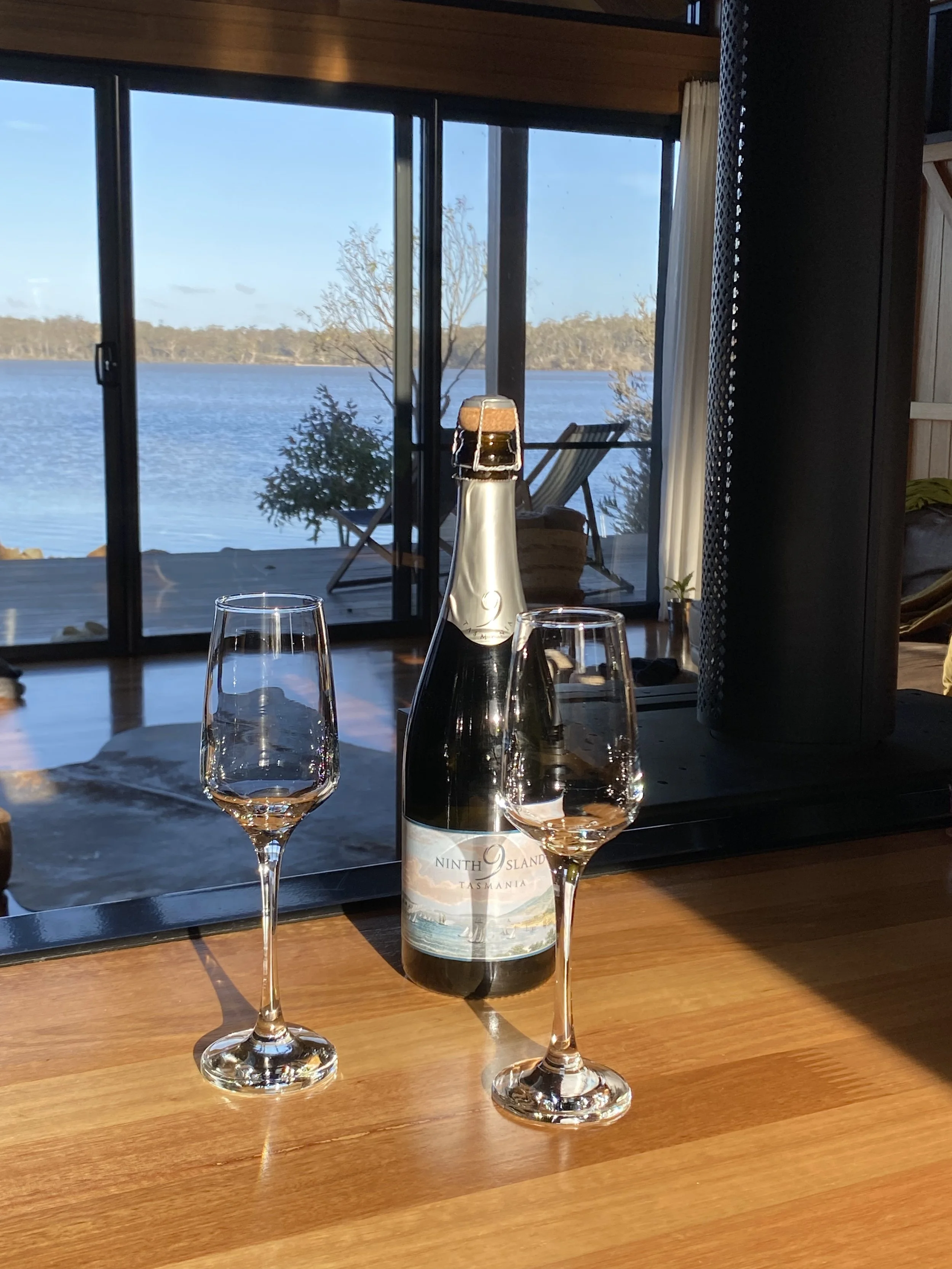
… and a bubbly welcome!
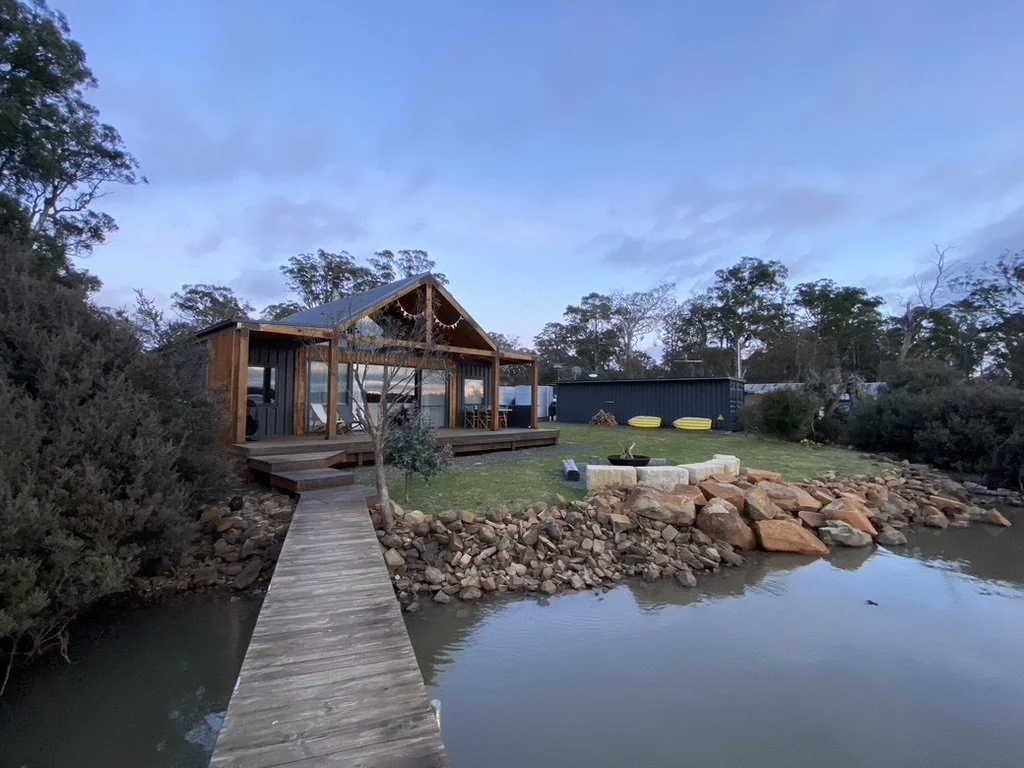
The Doctor’s
Except not quite. The following day, after our first decent night sleep without the squeaking of air mattresses for some time, we set out for a morning kayak, utilising those supplied by our hosts. We planned to reach the other side of the lake some one-and-a-half kilometres away. Off we went and all was well for twenty minutes. We were about half way across when I noticed I was labouring more intensely than my partner. True, I am twice her weight at one hundred kilograms, but I am also stronger. Yet she seemed to be gliding almost effortlessly across the water whereas I was sweating like a galley slave. After she slowed down and started to monitor my vessel, she noted it was in fact riding increasingly low in the water. Nonetheless I battled on, finding it more difficult to steer as my rear end sank deeper and deeper. Finally, with only thirty meters to shore, I sank to the soundtrack of defeated thrashing, noting my partner’s amusement.
The drive west to the somewhat ‘special’ town of Corinna was almost five hours, so we broke it up by stopping at the stunning Nelson Falls near Queenstown for a half hour stroll in lush temperate rainforest, which was a taste of things to come…
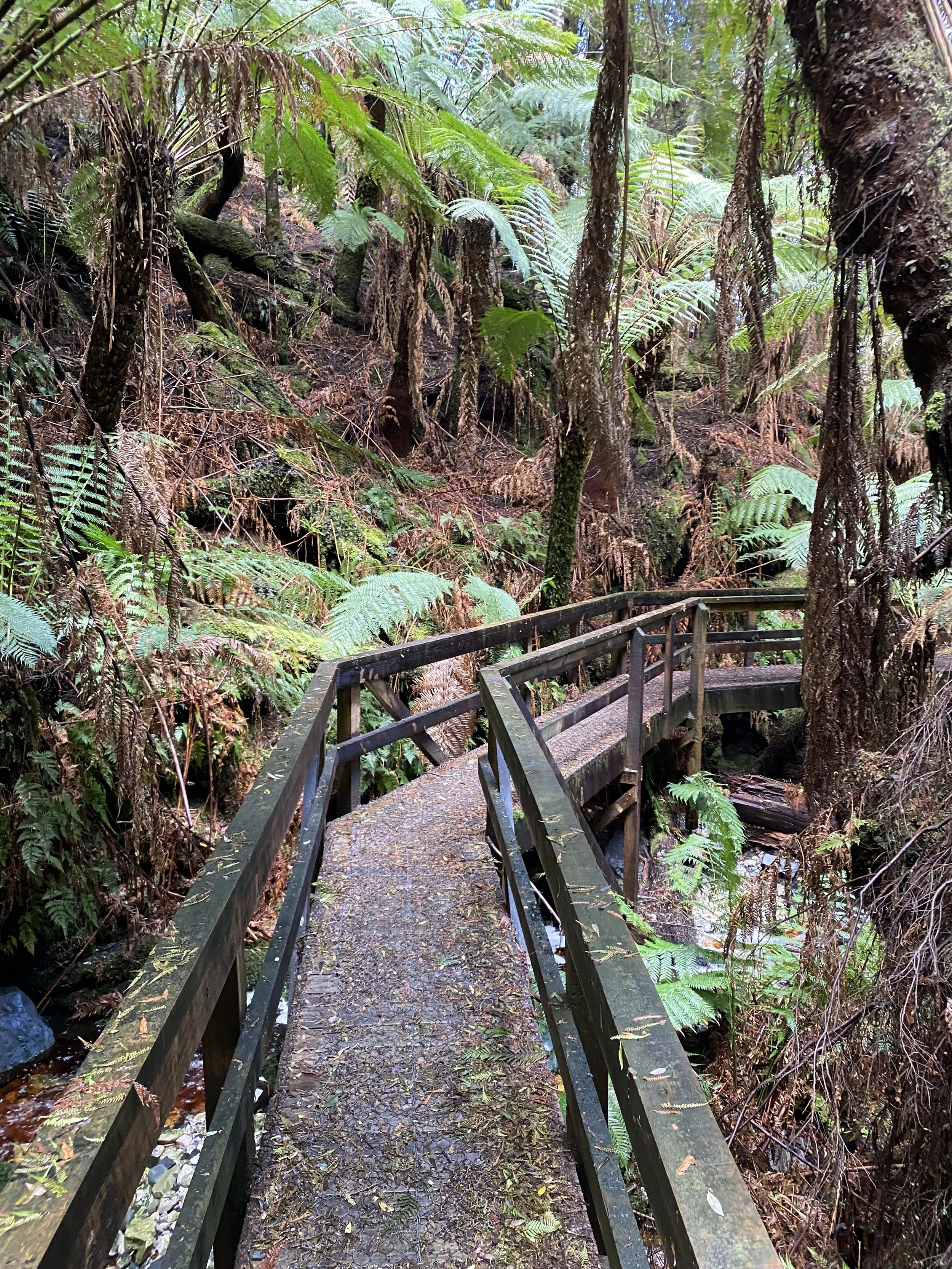
The Tasmanian loop continues into forests and falls…
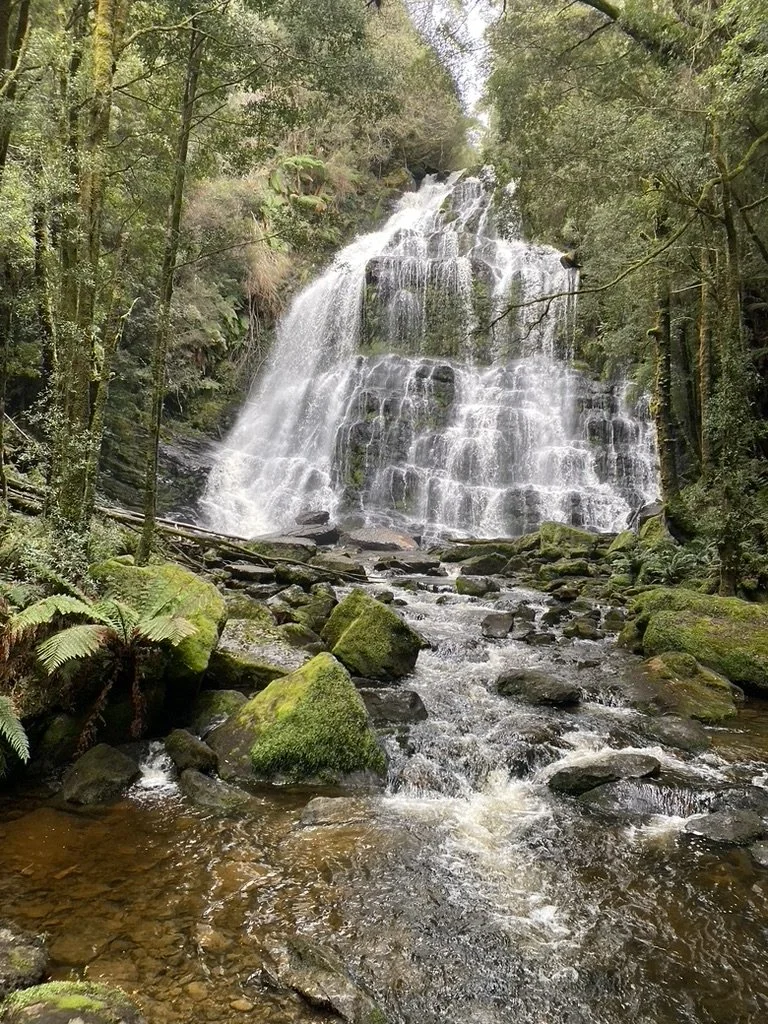
Nelson Falls
We had to press on, because the town of Corinna is not accessible by car from the south without having to cross the Pieman River on a car ferry, which stops at 7pm. Apparently you had to press a button to summon the ferryman to come across and collect you! Driving our sporty Corolla in a spirited manner in increasingly heavy rain, it became evident that it would be a close call. The unsealed road surface continued to deteriorate as we got closer and the burnt forest through which we were driving made for a hauntingly desolate impression, far from what was expected of a region known as the Tarkine. Standing in the rain at 6.50pm I pressed the button and returned to our car. About five minutes later we could make out some movement across the river in front of a low building. Rather than the grim reaper coming to get us, it felt we had been saved, for if we had missed our chance, the drive back to accommodation options would have been long and grim.
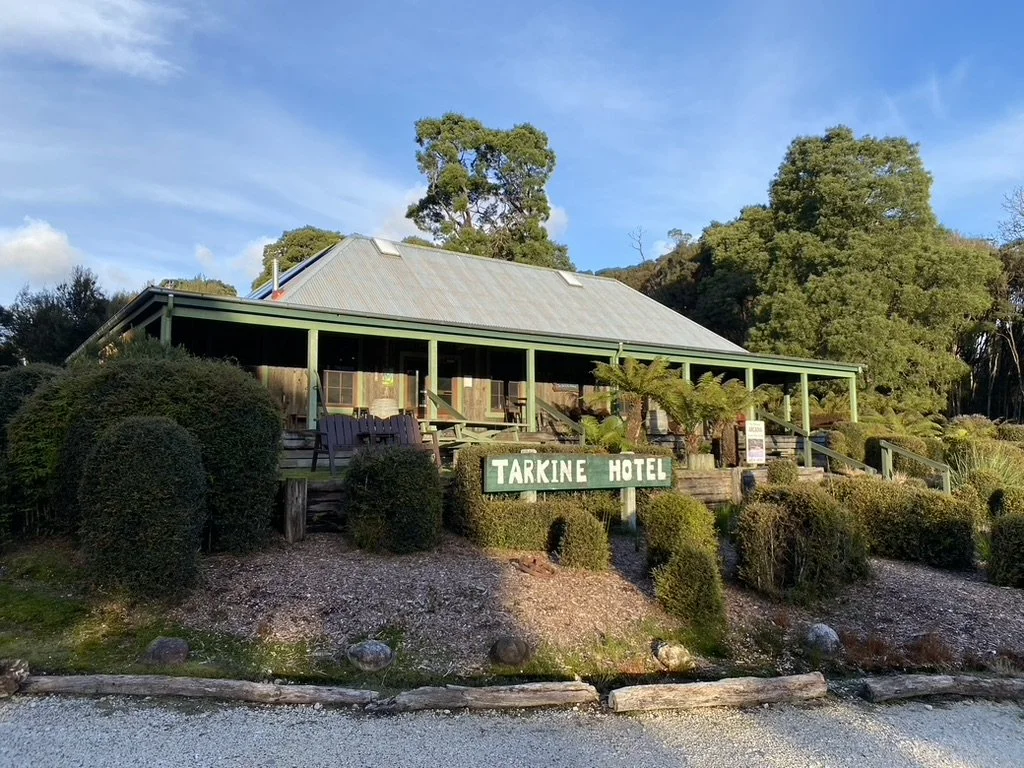
The Tarkine Hotel in better light the second day there
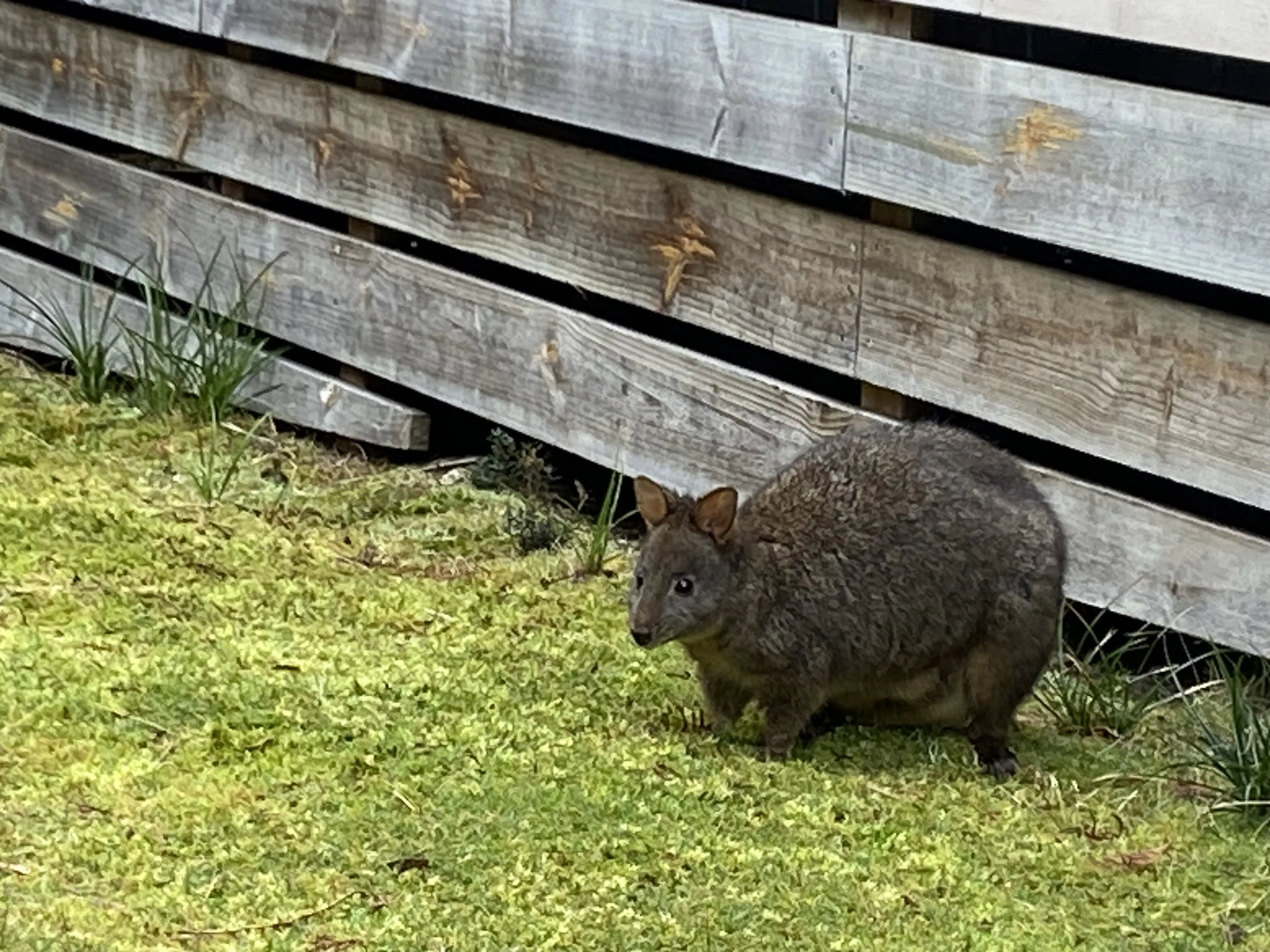
Our neighbourly Pademelon
The Tarkine Wilderness company operates Corinna as a retreat for those like us wishing to explore Australia’s largest temperate rainforest wilderness. We registered our arrival in the sole administrative and building The Tarkine Hotel, where they made us feel immediately welcome by serving us fine dining despite our late arrival. We found our quaint and functional cottage and looked forward to a couple of days of light walking within this unique region. Like the Blue Tier Forest on our first day, the Takayna - as it is known in the local aboriginal language - was absolutely stunning. Pademelons said good morning and a walk from our cottage into the forest surrounding it felt like stepping into another world, the world of Gondwana, some two hundred million years ago. A small boat captained by a knowledgeable and interesting character took us on a river cruise where we visited the Secret Staircase to Lover’s Falls and the ancient Huon pines hugging the river here and there. While early Europeans might be forgiven for their early logging interests, it seems inconceivable and damming that this region is still under threat from mining concerns.
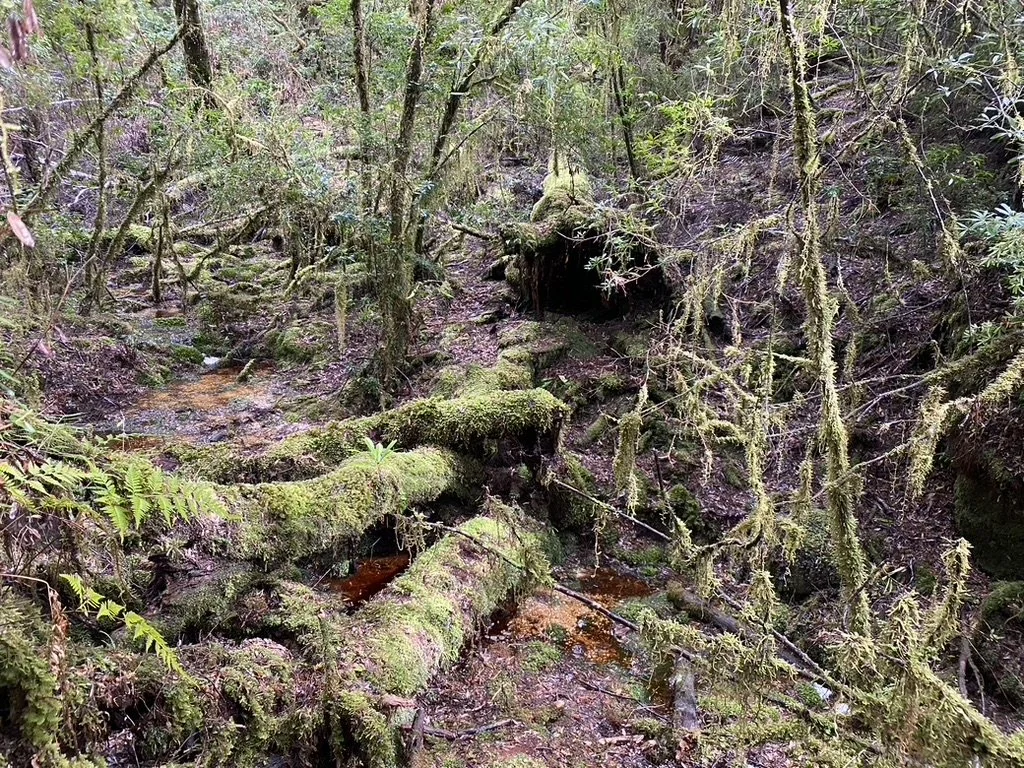
Classic Gondwana tangle of vines and fallen trees carpeted with moss
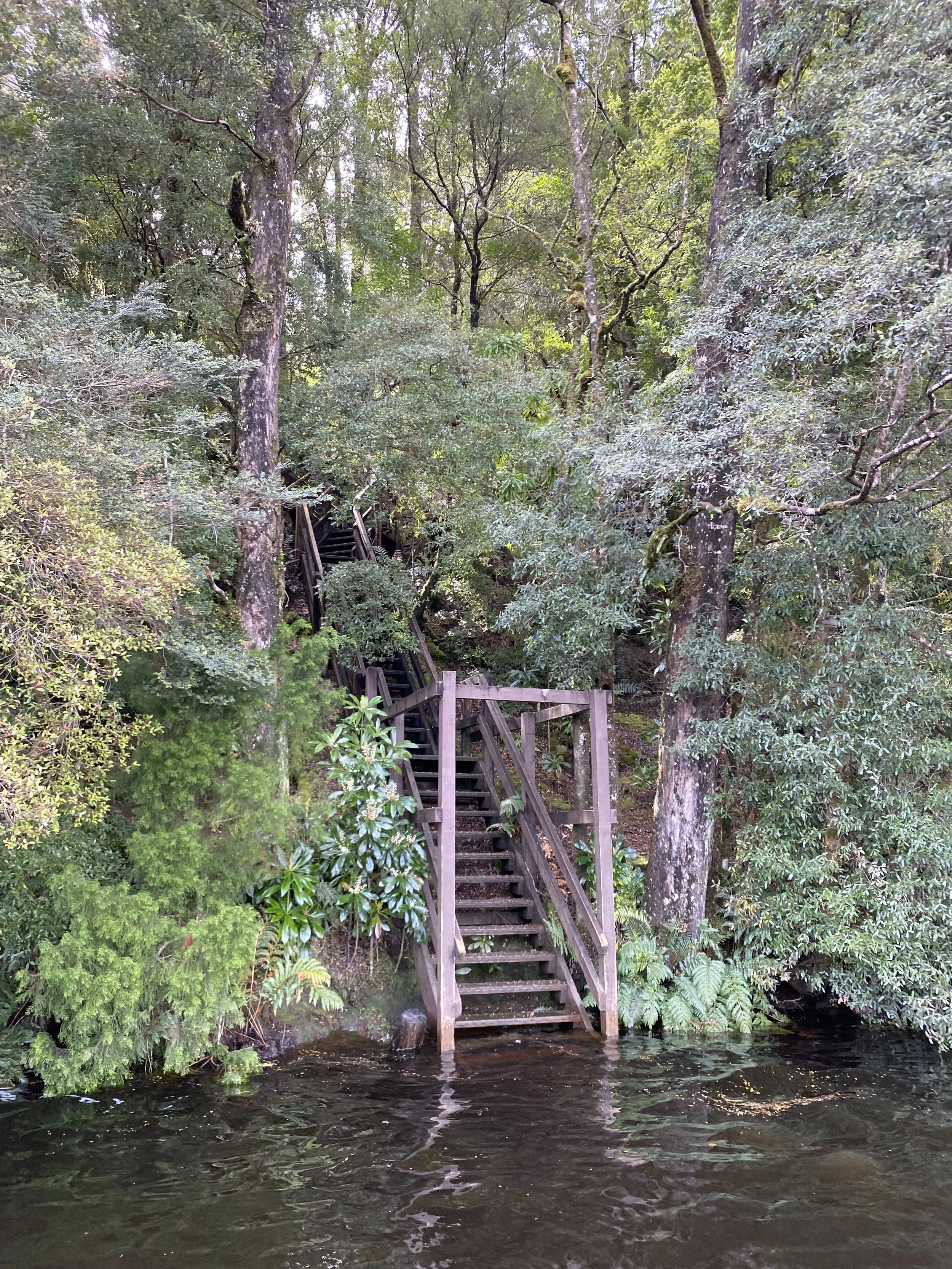
Our charming and eccentric boat captain steered us to and led us up The Hidden Staircase to Lover’s Falls
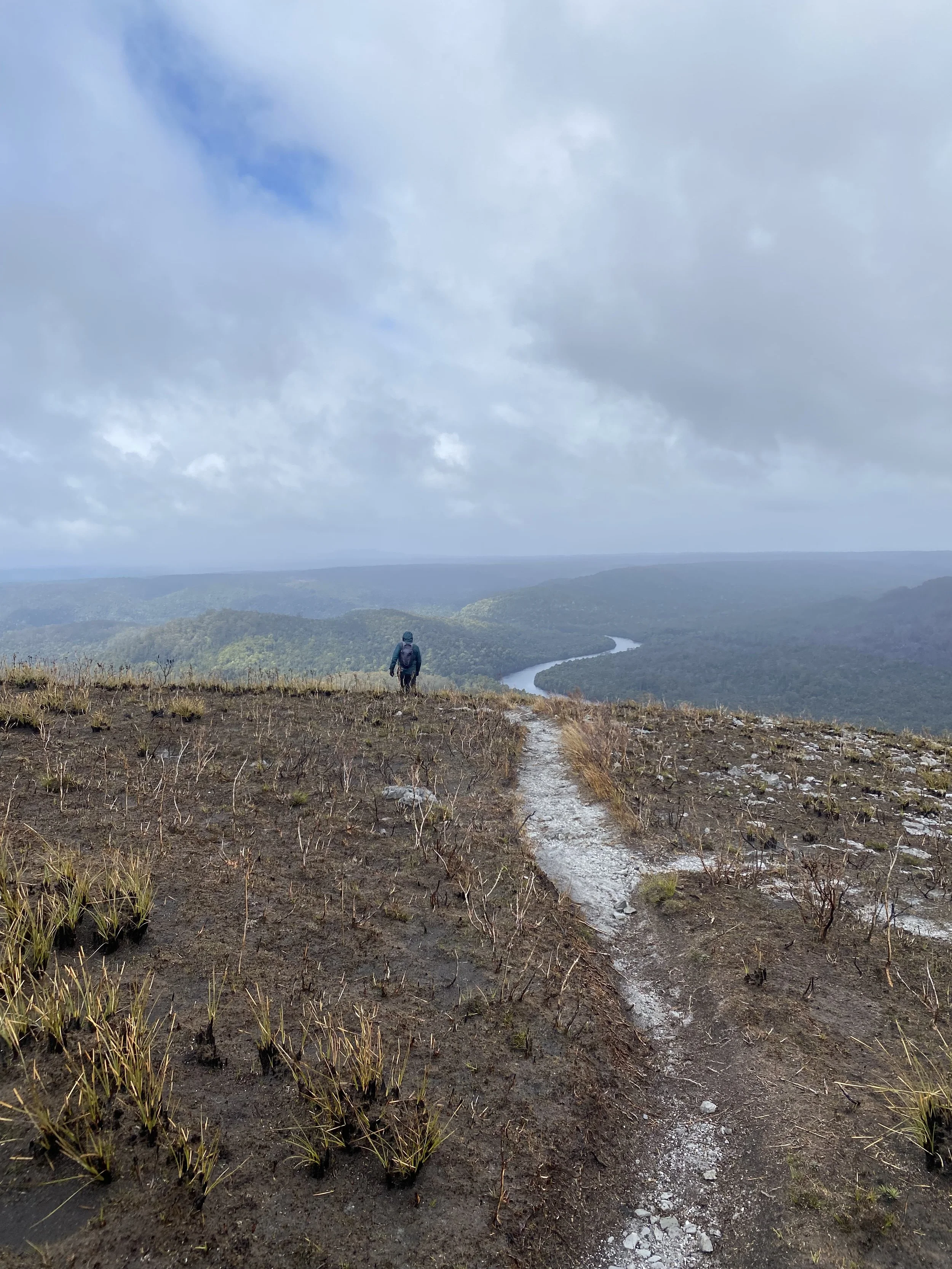
A rather cold, windy and bleak hike up to the summit of Mt Donaldson after leaving Corinna
It felt sad to leave Corinna behind and with that feeling you must return someday, but since we were heading for Cradle Mountain, the finale of the trip, we soon perked up, the drive being only a couple of hours. Our luxury accommodation was a cabin in the woods a few minutes drive from the main entrance to the national park. We planned to do day hikes over the next four days, returning to our underfloor heating, cheese and wine and king sized bed, a stark contrast to Maria Island.
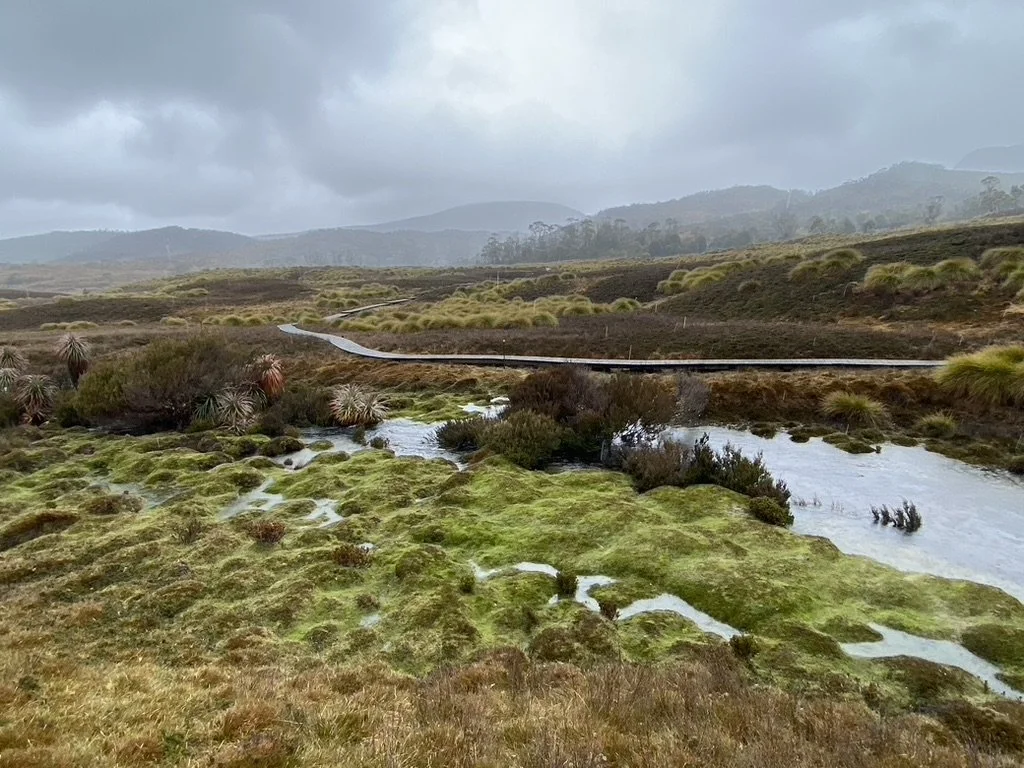
Cradle Mountain National Park
Although the weather did not play along entirely, we still managed some stunning hikes in the area, with sunshine and light rain dancing along with us. Summiting Cradle Mountain was ill-advised, as snow and poor weather remained up there. This we could confirm as we attempted to go up as far as possible, perhaps to within four or five hundred metres, before my partner, who could no longer see where she was going, felt she would be blown off the ridge while I hesitated with numb feet waterlogged from hiking up the ice cold stream.
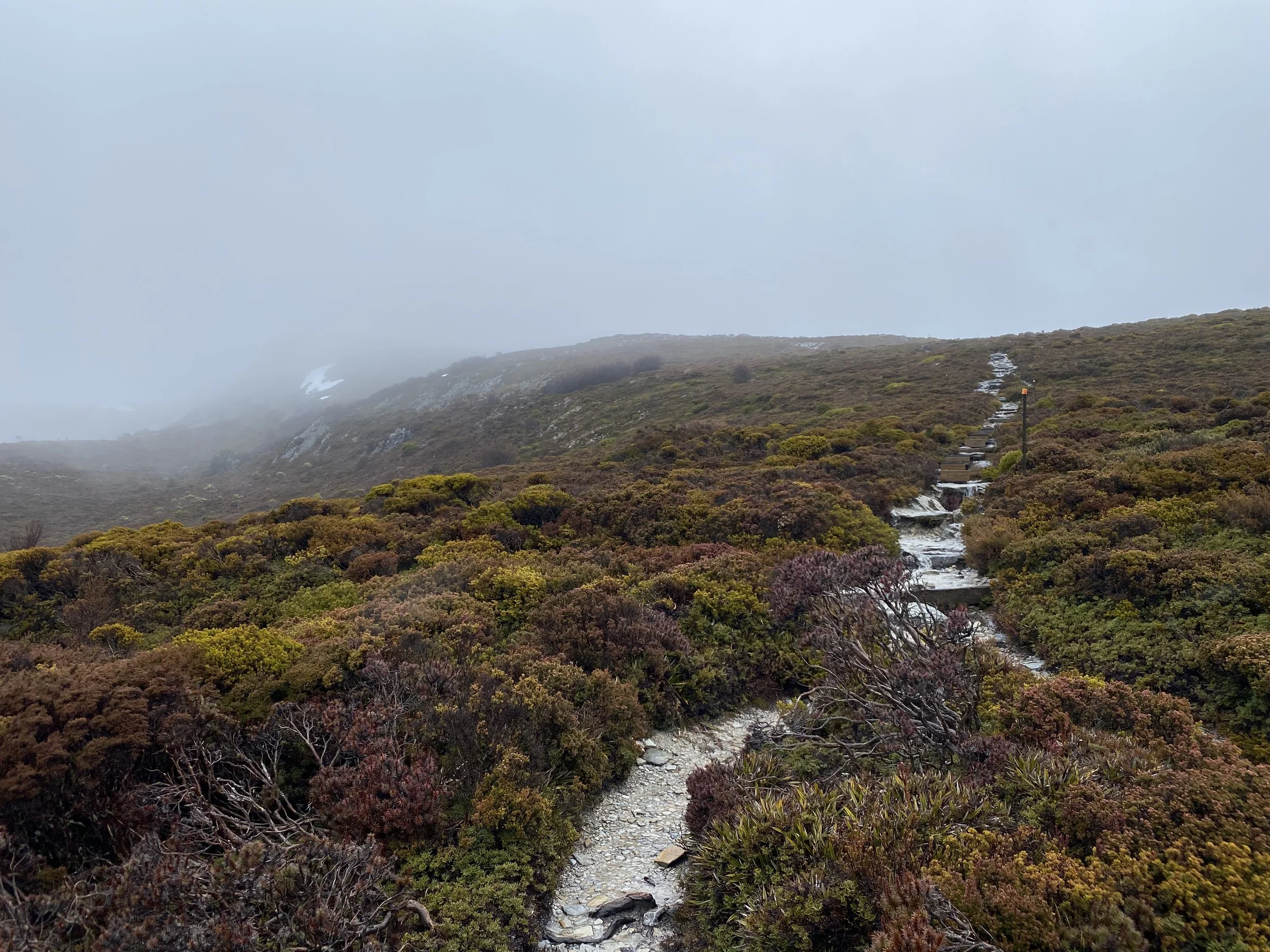
When it was not so bleak we couldn’t take photos
Another day we revelled in a crater lake and the geology of the region in general was so fascinating that I have since rekindled my passion for the subject. The Cradle Mountain area can boast having undergone sedimentation, igneous activity, metamorphism and glacial activity over its tumultuous and awesome epochs of time. When I return to Cradle Mountain some day - yes when, not if - I hope I will have the knowledge to appreciate hiking in four dimensions – the fourth dimension being geological time. Another time, another feature...
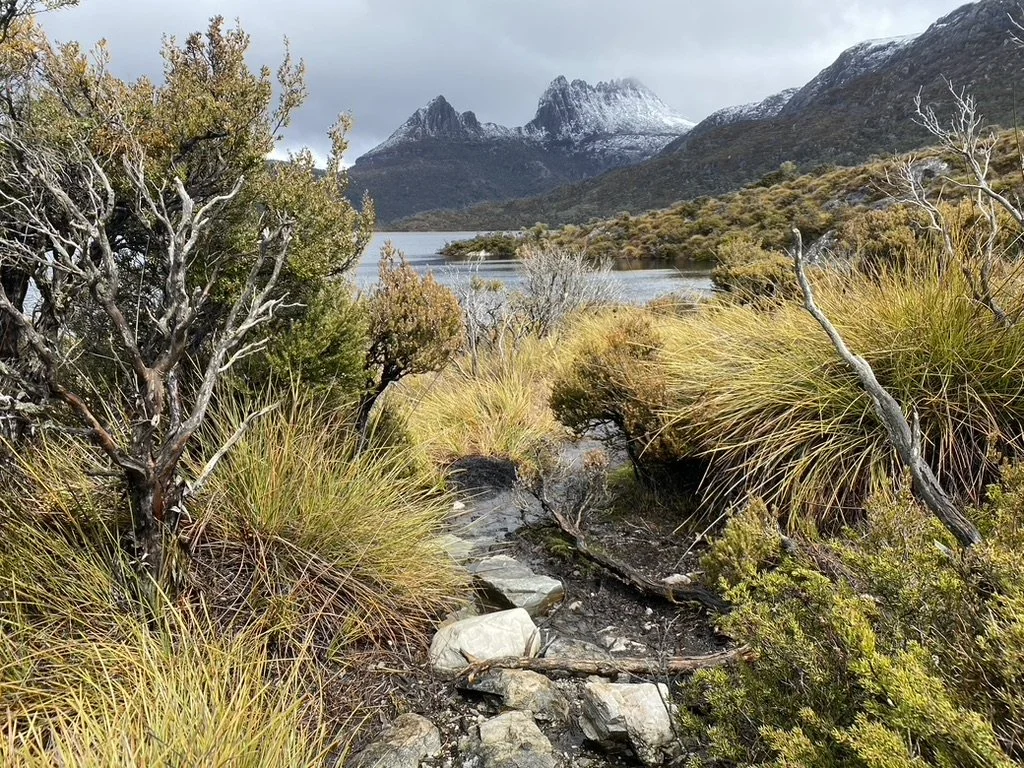
Cradle Mountain
The weather had the last say in the adventure, as we had to evacuate our cabin at 6am on the penultimate day, the resort company playing safe with insurance presumably. I think my partner’s disappointment was the greater as she wanted me to experience as much of this wonderland as possible, whereas I remained enthralled by what I had seen and comforted by the certain likelihood that I would return some day to attempt the summit and further explore the geology, fauna and flora of these magnificent lands.